Showing posts with label Karate - Shotokan. Show all posts

2nd Dan Karate Black belt

2nd Dan Black belt requirements 

 The Shotokan Karate 2nd Dan Black Belt is the tenth belt given to practitioner of this Martial Art.
Kihon
All kihon and combination teckniques are performed from Jiyu Dachi
Kizami-Zuki, Mae-Geri, Sanbon-Zuki (step forwards3 times )
Age-Uke, Kizami-Mae-Geri, Gyaku-Zuki, Gedan-Barai (step back 3 times )
Uchi-Ude-Uke Kokutsu-Dachi, Kizami-Zuki, back leg Mae-Geri step back, Gyaku-Zuki ( step forwards 3 times)
Soto-Ude-Uke, Yoko-Empi-Uchi, Uranken, Gyaku-Zuki, Gedan-Barai ( step back 3 times)
Shuto-Uke, Kizami-Mawashi-Geri, Nukite (step forwards 3 times)
Mae-Geri, Oi-Zuki, Gyaku-Zuki (turn step forwards 3 times)
Yoko-Geri-Kekomi Jodan, Zencutsu-Dachi, Urankan-Uchi, Gyaku-Zuki (step-forwards 3 times)
Mawashi-Geri, Jodan, Urankan-Uchi, Gyaku-Zuki (turn step forwards 3 times)
Mae-Geri-Chudan, Mawashei-Geri-Jodan, Urankan, Gyaku-Zuki, Gedan-Barai (same leg) step forwards 3 times
Mawashei-Geri, Jodan, Yoko-Geri-Chudan, Uranken, Gyaku-Zuki, Gedan-Barai (same leg) turn step forwards 3 times
Kizami, Yoko-Geri-Kekomi, step Mae-Geri, Oi-Zuki-Gyaku-Zuki (3 times)
Kizami-Mawashei-Geri, Ushiro-Geri, Gedan-Barai (turn step forwards 3 times)
Yoko-Geri-Keagei, Yoko-Geri Kekomi (same leg) from Kiba-Dachi (3 times)
Step forwards Mae-Geri, Oi-Zuki, Gyaku-Zuki, step back Gedan-Barai, Gyaku-Zuki, step forwards Yoko-Geri-Kekomi, Urankan-Oi-Zuki
Zenkutsu-Dachi Shomen (kicking with the same leg)
Mae-Geri to the front Yoko-Geri-Kekomi to the side, Ushiro-Geri to the rear, Mawashi-Geri to the front; 3 times each side

Kumite
Go-hon kumite (five step sparring)
Jodan, Chudan attacks
Kihon- Ippon (one step sparring)
1x Jodan, 1x Chudan, 1x Mae-Geri, 1x Kekomi, 1x Mawashi-Geri, 1x Ushiro-Geri: both-sides
Jiyu-Ippon Kumite (semi free style sparring)
1x Jodan, 1x Chudan, 1x Mae-Geri, 1x Kekomi, 1x Mawashi-Geri, 1x Ushiro-Geri: both sides
Jiyu-Kumite (free-style sparring) against 3 consecutive Dan grades

Kata
Candidates choice from :
Bassai Sho - Kanku Sho - Tekki Nidan - Ni Jushiho - Jitte
Any previous Kata of the Examiner's choice.

Information on Karate terms

Kihon (基本, きほん) is a word (Japanese) that means "basics" or "fundamentals" and is used to refer to the basic techniques that are taught and practised as the foundation of most Japanese martial arts.
Kihon kata is prearranged partner drills. Here, two students face either other and alternate execution of a technique. This approach combines repetition with training in distancing. Targets for punching and kicking, such as bags, shields, or dummies, are also commonly used in kihon training to strengthen muscles, bones, and even skin.
Kumite (組手) is a word that  basically means sparring. It is one of the three primary sections of karate training, along with kata and kihon.  Kumite can be used to develop a particular technique or a skill or even used within a competition.
Kata is a word which is a way of describing detailed choreographed patterns of movements. There have been conflicting stories on why this has been created but the most commonly accepted explanatino is that it acts as a reference guide for a set of moves which can then be used in a sparring scenario. The main objective here is to try out different combinations of techniques in a safe manner.

Karate Black Belt - Shotokan

1st Dan Karate Black Belt

To obtain this belt usually requires 6 months of continous training from brown belt with two stripes. The next belt after this belt is 2nd Dan Black Belt.

Black belt requirements

Kihon
All Kihon and combination techniques are performed from Jiyu Dachi
Sanbon Zuki [jodan, chudan, chudan] (step forwards 5 times)
Age Uke, Gedan Barai, Gyaku Zuki (step back 5 times)
Soto Ude Uke, Yoko Empi Uchi, Uranken Uchi, Gyaku Zuki, Gedan Barai (step forwards 5 times)
Uchi Ude Uke from Kokutsu Dachi, Kizami Zuki, back leg Mae Geri, step back to Zenkutsu Dachi, Gyaku Zuki (step back 5 times)
Shuto Uke from Kokutsu Dachi, Kizami Mawashi Geri, Nukite Uchi (step forwards 5 times)
Mae Geri, Oi Zuki, Gyaku Zuki (step forwards 5 times)
Yoko Geri Kekomi from Zenkutsu Dachi, Uranken Uchi, Gyaku Zuki, Gedan Barai (step forwards 5 times)
Mawashi Geri, Uranken Uchi, Gyaku Zuki, Gedan Barai (step forwards 5 time)
Mae Geri, Mawashei Geri, Urankan Uchi, Gyaku Zuki, Gedan Barai (step forwards 5 times)
Mae Geri, Yoko Geri Kekomi, Uranken Uchi, Gyaku Zuki, Gedan Barai (step forwards 5 times)
Yoko Geri Keage, Yoko Geri Kekomi (same leg) from Kiba Dachi (3 times)
Mae Geri, Oi Zuki, Gyaku Zuki, step back Gedan Barai, Gyaku Zuki, step forwards Yoko Geri Kekomi, Uranken Uchi, Oi Zuki (step forwards then turn and repeat)
Zenkutsu Dachi Shomen, (kicking with the same leg)
Mae Geri to the front, Yoko Geri Kekomi to the side, Ushiro Geri to the rear, Mawashi Geri to the front (3 times each side)
Kumite
Gohon Kumite (Five Step Sparring)
Jodan and Chudan
Kihon Ippon (One Step Sparring)
1 x Jodan, 1 x Chudan, 1 x Mae Geri, 1 x Yoko Geri Kekomi, 1 x Mawashi Geri, 1 x Ushiro Geri: both sides
Jiyu Ippon Kumite (Semi Free Style Sparring)
1 x Jodan, 1 x Chudan, 1 x Mae Geri, 1 x Yoko Geri Kekomi, 1 x Mawashi Geri, 1 x Ushiro Geri
Jiyu Kumite (Free Style Sparring) against two consecutive Dan grades.
Kata
Candidates choice from :
Bassai Dai - Kanku Dai - Jion - Empi - Hangetsu
Any previous Kata of the Examiner's choice.


Information on Karate terms
Kihon (基本, きほん) is a word (Japanese) that means "basics" or "fundamentals" and is used to refer to the basic techniques that are taught and practised as the foundation of most Japanese martial arts.
Kihon kata is prearranged partner drills. Here, two students face either other and alternate execution of a technique. This approach combines repetition with training in distancing. Targets for punching and kicking, such as bags, shields, or dummies, are also commonly used in kihon training to strengthen muscles, bones, and even skin.
Kumite (組手) is a word that  basically means sparring. It is one of the three primary sections of karate training, along with kata and kihon.  Kumite can be used to develop a particular technique or a skill or even used within a competition.
Kata is a word which is a way of describing detailed choreographed patterns of movements. There have been conflicting stories on why this has been created but the most commonly accepted explanatino is that it acts as a reference guide for a set of moves which can then be used in a sparring scenario. The main objective here is to try out different combinations of techniques in a safe manner.

The Top 10 Reasons to Start Karate By Paul A. Walker


People often wonder why karate is such a popular activity. There must be a primary reason why someone would get involved in the martial arts. Actually there are many reasons for embarking on the study of martial arts but generally the main motivations boil down to my "Top Ten Reasons to Start Karate".
So think about what your main reason for starting karate is (or was) and see if it matches my "Top Ten".
1. Self-Defense - Were you ever bullied at school? Have you ever worried about how to protect yourself and your family in a dangerous situation or environment? Well, it seems that you're not alone because thousands of other current martial arts practitioners say that self-defense skills for today's world are the primary motivating factor for them to enroll in karate classes.
2. Health and Fitness - Had enough of generic gym workouts? Sick and tired of the same old aerobics class with that annoying music? Many other people have had enough too and are now turning to the martial arts as a great way to improve their health and fitness while gaining many additional benefits through their training.
3. Discipline - This seems to be the number one reason quoted by parents of young children for joining a karate club. Discipline is one of the core tenets of the martial arts and if you are already the parent of a "wild child", then it's not too late to change their behavior through the time-tested methods of a qualified karate instructor.
4. Confidence - Do you lack self-confidence? Come on, be honest - do you tend to do what others tell you to do, or do you stand up for yourself and lead the way in your life? The fact is that the majority of people follow the crowd instead of leading the pack. The study of martial arts is the perfect template for developing core leadership skills and improving self-confidence and many people are beginning to notice this. Have you noticed yet?
5. Self-Control - This can be defined as being the ability to appropriately monitor your own behavior and natural impulses when put under pressure by life's everyday challenges. The way you react to negative events or stress often defines who you are. Martial artists are by no means impervious to the trials and tribulations of life but they are often better equipped to deal with such obstacles through their constant and rigorous training.
6. A New Challenge - Are you tired of doing the same old thing day in and day out? Do you feel that you need a new direction in your life? A simple solution is to try something different and karate is a great activity with many hidden benefits - just look at this "Top Ten" list! Why not give it a try?
7. Social Interaction - Human beings by their nature need social interaction with other human beings. Often this need is met at home or at work but these environments are not always the most harmonious of places. Why not step out of your comfort zone? How about you make some new friends who share a common goal - that of self-improvement!
8. Spiritual Growth - Confusion in our modern world is a cause of immense stress and the need for spiritual guidance is great. Many people turn to religion for the answers to this angst, some people begin meditation or yoga, and others are turning to martial arts to reconnect with themselves and discover the true being within. Any of these methods can provide answers; it's up to you to discover which one works best for you personally.
9. Learning about a New Culture - Many modern martial arts can trace their roots back to different countries such as China, India, Japan, Korea, Greece, Philippines, Thailand, and numerous other countries. As the martial arts provide such a culturally rich background, they are often a great initial introduction to learning about our wider world, its history and its diverse cultures.
10. Because my Friend told me it was Fun - Have you ever watched a movie because a friend recommended it? Have you bought a new pair of shoes because you were told they were extremely comfortable? How about a new car? There are many examples in everyday life where we act based on trust in our loved ones' opinions. Beginning karate is no different and in many ways studying martial arts is a referral-based business.
So these are "The Top Ten Reasons to Start Karate" and if you haven't "stepped out on the mat" yet then I sincerely hope you take action soon. If you are already a karate practitioner, then congratulations on taking the first step on your rewarding journey.
I'd like to hear your story, just send me an e-mail at Paul@freekarateinformation.com. And if you still need some more convincing then check out my FREE Report, "Karate For Newcomers: How to Find Out Everything You Need to Know to Start Your Karate Practice." You will be able to get it at http://www.freekarateinformation.com
********************************
Sensei Paul Walker, is a 4th degree black belt karate instructor with over 25 years of experience in the martial arts. In June 2003 he attained his 4th degree black belt, after studying with the legendary Karate Master, Hirokazu Kanazawa at his Headquarters Dojo in Tokyo for three years from August 1996 to July 1999. Sensei Walker has operated his own karate training center in Southern California for the last five years.
Additional free information on karate for people who are investigating, just beginning, are advanced in their practice, or who are instructors, is available at Paul's website at http://www.freekarateinformation.com

Today I Got My Second Black Belt (2 Dan)

Jion Kata .. black belt Test ( 2 Dan )


Jion, an introduction


Jion is the first Kata a student normally encounters from the "temple Katas". It is normally at this point that they are told about the "temple" Katas and how they are related. In my research, this seems to be one of those false stories that is passed on from instructor/Senior to junior and then becomes Dogma.  The truth is that all three Kata (Jion, Jutte and Jiin) may all be related and or from the same area of Okinawa, being the Tomori area, but they were not in fact created at some Temple.  First off Jionji or Jion-Ji is a temple in Japan's Gujo Hachimon town in Yamagata prefecture....a fair way away from Okinawa!  So, it is not likely that the Kata took its name from a Japanese temple when it was created in Okinawa years before Karate came to Japan!  

Having said that, all three Kata are linked and have similar movements. Jion and Jiin are virtual twins with only some variations of the movements. And Jutte has a similar feel and opening preparation stance. They surely could have been created by the same person or around the same persons teachings.

The first of the three Katas (meaning Jion in this case) teaches a student how to deal with rotational movements, and directional shifts. It is also a great Kata for more powerful students. The basic feel of the Kata is only overshadowed by the powerful movements and destructive nature of the Kata. The essence of the Kata is to meet the opposition straight on and honestly, with no hidden or secret movements.  All three of the "temple" Kata have valuable lessons interwoven into the practice of them. But as I stated, there is a lot of suspicion as to the dubious history attached to the Katas’ past.

History of Jion


Jion is a very common Tomari Kata whose history is a bit fuzzy. It is accepted that it has roots in the Tomari style of Karate and has "family" roots with both Jiin and Jutte! Jion, or Gion as it is sometimes written, also has strong Buddhist flavours in it and as such also has links to the Shaolin Tradition and some connections to the Kata Passai / Bassai and Wanshu / Empi.  

The name for this Kata is thought to describe its roots and creation at the Buddhist temple Jion-Ji, but this is doubtful.  The name may be translated as a direct reference to the Jion-ji temple or less commonly as "temple bells".  At some point in the transportation of the Kata from Okinawa to Japan, Gichin Funakoshi felt that he should change the name of Jion and replace it with a more "suitable" name that described the feelings that he thought would bring meaning to the Kata for the students learning this Kata.  He attempted to change the name to Shokyu or 'Elimination', a name meant to describe the feeling of total dominance and destruction of the opponent. The name did not stick and the old name came to be used again for this Kata. Funakoshi had tried to change many names to "Japan-ize" them and make them more acceptable to the Japanese, few stuck.

Funakoshi learned Jion from his primary instructor Itosu sensei and Itosu learned this Kata from his instructor Matsumura.  The Kata is a common Kata to the Tomari Region and the Shuri Region.  Some literature I have found suggests the original name was more properly pronounced Jihon.  The Chinese Ideogram from Jihon does appear more frequently in Chinese writing in reference to this Kata.

Some Interpretations of the Kenji used for the Kata suggest a different meaning for the Kata name. One Kenji used for 'Ji' is to develop techniques and ability, and 'on' is to condition or forge the body.  Granted this is not mainstream and is more than likely a descriptive from a old instructor to illustrate a feeling for the Kata. But, it does play into the feel of the kata when performed properly. The name could mean to "develop techniques to condition the body" and not "temple bells" and would fit the Kata almost better than the accepted name.

Itosu was taught the Kata by his instructor Matsumra when he returned from China and this was likely its introduction to Okinawa.  Itosu was also said to have gone to Hanashiro chomo, a Fellow teacher and a schoolteacher and friend of Itosu’s to help further develop or ' Okinawan-ize' the Kata. Together they made this Kata more linear and used more traditional Okinawan characteristics in the newly re-formatted Jion.

Despite all of the mystery and issues with lack of information, what is known about Jion is it has roots in Chinese Gung fu, was taught by Sokon Matsumura to Itosu Sensei, modified by Chomo and Itosu to be more like his Shuri style and it is practised by styles with roots in both shuri and Tomari te. The date that the Kata was formalized in Okinawan Karate would be between 1663 and 1680, which is around the same time as Kusanku/Kwanku/ Kanku dai came to be practised on the island nation.

One more story of the Jion name has to do with a bridge named Jion and the inventor of the Kata working or practising on the bridge.  The inventor then named the Kata after the bridge. Again, some of the stories of how Kata are named are just that, stories.  Many a "story" has been made to be "history" by good intentioned instructors that know Karate but do not research its history.

Notes on Jion


Jion has a grandeur to it that should show through with all the movements.  This may be attributed to its strong Buddhist links or it may be because Jion is a powerful but very basic and honest Kata. Mistakes are very hard to hide in Jion due to its calm power and smooth transitions in the movements. Jion is often used for black belt testing because of its nature and the fact that a student must have good Kihon Waza to make the Kata run smoothly and with power.

Jion is also one of the favourite forms of many Kumite champions simply because it is direct and works on basic ideas and techniques.  This Kata should be done with the proper attitude and outlook or it will not produce an aesthetically correct form.

Over the years many of the smaller details of the Kata have changed and it is important to note that some of the changes were seen as going back to the root of the Kata to bring backs its original JKA flavour. But the Kata has always been a stand out in the Shotokan Syllabus.          

The breathing of the Kata is Nogare or natural to movements and not forced or over controlled during practice.  The movements should be crisp and direct with linear power being used.  The techniques should be rooted and students should be well versed in stance and movements to be able to shift when required and not shift when the Kata is not calling for this.


End Notes

When practising Jion, a student should have the proper spirit.  It is a Kata that brings out a powerful spirit and has a noble feel to it.  Nothing is hidden and all the movements should be performed with power and overpowering spirit. Jion is often forgotten when a student is being taught the junior Kata.  Much is said about Kanku Dai and often when a student is looking at learning Jion the fact that it may have been used to create the Heian Kata is omitted.

Jion is a very important Kata to practice to ground yourself in basic movement and principles when most students are looking to advanced Kata and more fancy movements.  Jion is more than the myth that has sprouted up about it being a Buddhist Kata or a Kata created at a Temple.  It is a Kata that works on improving a students power and dynamic use of the body in a very fundamental and basic way.

One of my most memorable moments with the Kata Jion was being taught this Kata by Master Tanaka at a summer camp.  Not only did he demonstrate a lot of the techniques that left us all knowing the potential of the Kata but he showed a great passion for the Kata and brought up many common sense ideas that most of us had over looked.  I came away with a renewed appreciation for a Kata that I had been losing interest in. I can again see the beauty in the basic and powerful movements of this Kata.

Empi or Enpi Kata (Wansu): Flying Swallow.( 3 Dan )


Empi Kata is a pre-arranged sequence of strikes using the elbows. The kata aims to demonstrate the jitsuka's knowledge of how to use one of the hardest weapons the body has to offer. The kata should be performed with full body movement and each strike should (of course) be solid and precise.
The kata may be performed on an individual basis or with a partner. If performed individually, the jitsuka should imagine their opponent to be of equal size. If an uke is available, they must take retreating mirroring steps as the tori advances, and the tori should make contact with each target, but with practically no force. No force does not mean that the strike should be feeble - quite the contrary. The strike should be strong, and the final movement should be firm but gentle.

Beginning

When beginning empi kata, the jitsuka should firstly perform a ritsu rei and then settle into a kiba dachi stance and may optionally announce their entry into the kata by calling out the name of the kata. The kata consists of 10 consecutive strikes, and may be performed at almost any pace - but slow and deliberate usually looks best! Each strike advances the jitsuka further forward from their original starting position. All directions given below are based upon the forward direction of the original kiba dachi stance. The instructor may ask to see the kata at the jitsuka's own pace, or he may count out each strike for the jitsuka.

Strike 1

Step:Right foot forward
Strike:Right elbow - driving up
Target:Jaw
Tori steps forward on the right foot and twisting at the hips drives his right elbow up in an arc to strike the jaw of an opponent directly ahead. The tori should end up stood side-on facing to the left.

Strike 2

Step:Left foot forward
Strike:Left elbow - driving up
Target:Jaw
Tori steps forward on the left foot and twisting at the hips drives his right elbow up in an arc to strike the jaw of an opponent directly ahead. The tori should end up stood side-on facing to the right.

Strike 3

Step:Right foot forward
Strike:Right elbow - dropping down
Target:Clavicle
Tori steps forward on the right foot and twists at the hips. Tori tries to achieve a flowing movement as he reaches up and straightens his right arm - almost coming up onto his toes. The tori then drops the arm, bending it at the elbow to strike down onto the left collar bone of an opponent standing directly ahead. The tori should end up stood side-on facing to the left.

Strike 4

Step:Left foot forward
Strike:Left elbow - dropping down
Target:Clavicle
Tori steps forward on the left foot and twists at the hips. Tori tries to achieve a flowing movement as he reaches up and straightens his left arm - almost coming up onto his toes. The tori then drops the arm, bending it at the elbow to strike down onto the left collar bone of an opponent standing directly ahead. The tori should end up stood side-on facing to the right.

Strike 5

Step:Right foot forward
Strike:Right elbow - driving across from right to left
Target:Back of jaw
Tori steps forward on the right foot and twists at the hips. Tori should aim to step slightly past his central line to the opponent (i.e. slightly over to the right). Tori uses this hip twist to drive his right elbow from the right to the left to strike the rear (left) part of the jaw or an opponent stood directly ahead. The tori should use his left hand to brace the elbow strike by supporting the right hand. The tori should end up stood side-on facing to the left.

Strike 6

Step:Left foot forward
Strike:Left elbow - driving across from left to right
Target:Back of jaw
Tori steps forward on the left foot and twists at the hips. Tori should aim to step slightly before his central line to the opponent (i.e. slightly over to the left). Tori uses this hip twist to drive his left elbow from the left to the right to strike the rear (right) part of the jaw or an opponent stood directly ahead. The tori should use his right hand to brace the elbow strike by supporting the left hand. The tori should end up stood side-on facing to the right.

Strike 7

Step:Right foot forward
Strike:Right elbow - whipping across from right to left then driving back from left to right
Target:Temple
Tori steps forward on the right foot and twists at the hips. Tori should aim to step slightly before his central line to the opponent (i.e. slightly over to the left). Tori draws his right arm across from the right to the left as the step is executed. At the moment the right foot settles firmly, tori unwinds and drives his right elbow from left to right. The strike is aimed at the right temple of an opponent stood directly in front of the tori. The hips and shoulders should be used in combination for the unwinding strike, and the tori should use his left hand to brace the elbow strike by supporting the right hand. The tori should end up stood side-on facing to the left.

Strike 8

Step:Left foot forward
Strike:Left elbow - whipping across from left to right then driving back from right to left
Target:Temple
Tori steps forward on the left foot and twists at the hips. Tori should aim to step slightly past his central line to the opponent (i.e. slightly over to the right). Tori draws his left arm across from the left to the right as the step is executed. At the moment the left foot settles firmly, tori unwinds and drives his left elbow from right to left. The strike is aimed at the left temple of an opponent stood directly in front of the tori. The hips and shoulders should be used in combination for the unwinding strike, and the tori should use his right hand to brace the elbow strike by supporting the left hand. The tori should end up stood side-on facing to the right.

Strike 9

Step:Right foot forward
Strike:Right elbow - swinging from right to left then left to right
Target:Groin
Tori steps forward on the right foot and twists at the hips. As he steps tori swings his right arm back (to his left) in striking position, with the left hand supporting the right. The tori should aim to make this step reasonably deep, and his weight should be sustained mainly on the back (left foot). The tori then swings his right arm in a low swing from left to right aiming for the groin of an opponent stood directly ahead. The tori should use his legs to set the height and to carry the swing throgh so that the strike is beginning to swing up at the end. The tori should end up stood side-on facing to the left.

Strike 10

Step:Left foot forward
Strike:Left elbow - whipping over from left to right
Target:Bridge of the nose
For the final strike the tori pivots on his right foot and swings his back leg around anti-clockwise to achieve a higher stance than before, but this time facing to the right. As he steps, tori changes to support his left hand with his right and describes an over the top swing down onto the bridge of the nose of an opponent stood directly ahead. On this final strike, the tori should let out an audible kiai.

Ending

At the end of the kata, the jitsuka should pause momentarily in the final position, and then draw his right foot around anti-clockwise to stand facing forward in a su dachi stance. With a final ritsu rei, the kata is complete.

heian shodan (1st KYU) the first kata in shotocan


Heian Shodan

Heian Shodan translates as, "Peaceful mind, first level." and is the first of the series of five Heian kata. It teaches the karateka to ground himself in strong stances. Thus it represents Earth. It is one of the most basic kata and is usually the first kata a karateka learns.
There is an emphasis on basic low blocks/strikes and stepping punch, moving through the center and building strong and low front stances, hammer fist technique and face blocks/strikes, including transitionally timed blocks and strikes, back stance knife hand block/strike, proper basic breathing and application of kiai. Hip rotation, vibration, shifting/thrusting, reconnection.

Heian Nidan (2nd KYU) Orange belt Test


Heian Nidan

Heian Nidan translates as, "Peaceful mind, second level." and is the second of the series of five Heian kata. It focuses on back stances and is the first kata to introduce the yoko geri (side snap kick). It represents wind. It is one of the most basic kata and is usually the second kata a karateka learns.
There is an emphasis on basic low blocks/strikes and stepping punch, moving through the center and building strong and low front stances, hammer fist technique and face blocks/strikes, including transitionally timed blocks and strikes, back stance knife hand block/strike, proper basic breathing and application of kiai. Hip rotation, vibration, shifting/thrusting, reconnection.

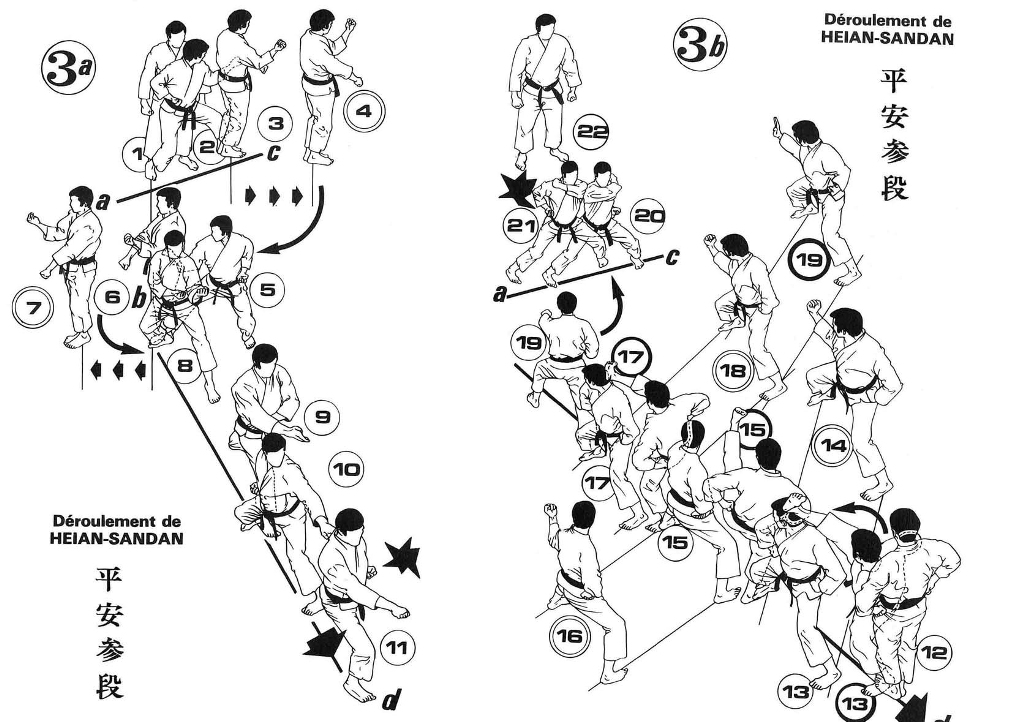
Heian Sandan (3rd KYU ) Green Belt Stage


 An application of the Kata ..

i saw many videos on youtube for players , The problem in the way of doing kata cause many players put all his / her focus on the moves and forgot the technique like the sitting position like this video ..


ABOUT THE KATA ..
Heian Sandan translates as, "Peaceful mind, third level." and is the third of the series of five Heian kata. It represents fire.
There is an emphasis on multiple blocks, trapping/breaking techniques, release from wrist locks and grabs, forearm deflection and back fist strikes, defense from various grabs and holds, proper basic breathing and application of kiai. Hip rotation, vibration, shifting/thrusting, reconnection.

Heian Yondan - (4TH) هيان يوندان


It’s quite common for many students once they have passed a grade, to never really feel the need to continue their study of the Heian Kata. It’s quite common for black belts to have completely forgotten their previous kata, being so caught up studying Bassai, Empi, Jion and Hangetsu.
However, continued attention and study of these Heian Kata should follow, and not just up to Black belt. Many very senior Dan grades devote most of the kata training time to the Heian kata’s, for these kata teach such important fundamentals, and need to be perfected for a lifetime.
Heian Yondan, the fourth in the series is a very popular kata. More than any of the earlier Heian Kata, Yondan introduces a new type of rhythm to kata training. It has interesting contrasts between very deep and slow to incredibly sharp movements. This contrast between slow and fast introduces rhythm to the beginning student, and helps them to develop the control to not just rush through the kata. It helps them develop their leg movements, and the ability to synchronize leg and arm movements.
This kata introduces juiji-uke, Shuto-uchi, kakewake-uke, and hiza-geri, and perfection of these new movements is imperative in your continued study of the rest of the Heian series.

Heian Godan The 5th And Final kata in the Heian Series


Heian Godan The 5th And Final kata in the Heian Series

Heian Godan , translates as peaceful mind fifth level, Heian Godan is the fifth and final kata in a series of five Heian kata, for the first time it incorporates, mikazuki geri (crescent kick), a jump several instances of simultaneous block and counter.

Tekki shodan kata (6 ..KYU) تكي شودان


The kata are performed entirely in 'Sitting position' Kiba dachi ("Horse riding stance"). The name Tekki itself (and Nifanchin) translates to "Iron Horse."
The Tekki series of kata are great conditioning for the legs and with practice, develop explosive power in the legs.
In the earlier days of karate training, it was common practice for a student to spend 2-3 years doing nothing but Tekki, under the strict observation of their teacher. Motobu Choki, famous for his youthful brawling at tsuji (red-light district), credited the kata with containing all that one needs to know to become a proficient fighter.
in This link you will find all you want to know about about this kata ,
http://www.squidoo.com/tekkishodanThis Video Show the Technique ..

Bassai Dai (Major) black belt one dan


This form has been used and practiced in many cultures, including China, Okinawa, Japan and Korea. The origins of this kata are obscure, however there are several theories as to its history. Some researchers believe the Passai kata is related to Chinese Leopard and Lion boxing forms, with some sequences bearing a resemblance to Leopard boxing (the opening blocking / striking movement in cross-legged stance) whereas others are more representative of Lion boxing (open handed techniques and stomping actions). Okinawan karate researcher Akio Kinjo believes that the name means "leopard-lion". Yet, in the style, Matsumuro Seito, the name of these katas are interpreted as "To break a fortress". Other historians have noticed the resemblance between some parts of Passai and Wuxing Quan ("Five Element Fist") Kung Fu. Here are the spellings in several Chinese dialects...

Karate ( THE ART )


Karate ( open hand )
is mean defense by using the open hands , is the art of highness up the spirit ,give you the the trust and show you the truth of yourself , learn you the spirit of challenge and what to do in difficult situations, Some people with scarcity saying if you faced a situation in the street what you will do you will have time to think to use Karate , actually the player of karate that he played for along time if he faced something in the street or against any enemy , he will just use karate without feeling !! cause all nature defense moves that normal people do is DELETED FROM HIS MIND AND REPLACED BY THE ART ..so KARATE SOMETHING WILL BE USEFUL FOR YOU WHATEVER YOU WILL USE IT OR NOT cause simply , in the first place is a body sport and MENTALITY SPORT ALSO will grow up inside you the spirit of challenge and confident about yourself and this all what we need in this life ..

Kanku dai ( Looking to the Sun ) Black belt (2dan)


About this kata is meaning of it looking to the sun ..One of the most longest Kata in Krate , have alots of moves , depends on a collection of moves from the last katas and new one have one jump have alot time to play it ,and need to make effort in it but it's moves very adorable , my favor Kata in the Art <3

Copyright © ASH
Designed by Templates Next | Converted into Blogger Templates by Theme Craft